The Science Says One Thing, but the 2:00 Am Reality Says Another: How to Establish Healthy Bedtime Routines When the Textbooks Fail You.
I’ve spent a decade in paediatric wards reading the glossy, colourful brochures that tell you exactly how to establish healthy bedtime routines using “gentle sleep cues” and “calming sensory environments.” They make it sound like a choreographed ballet of lavender oils and rhythmic rocking. But if you’ve ever been standing in a darkened hallway at 3:15 AM, listening to a two-year-old scream because their favourite stuffed elephant is “too loud,” you know those brochures are absolute nonsense. They tell you what should happen in a perfect world, but they rarely mention what to do when your child decides that bedtime is actually a high-stakes negotiation for more juice.
I’m not here to sell you a way to achieve perfection, because perfection doesn’t exist once you have more than one child in the house. Instead, I want to give you the middle ground: the actual clinical science of sleep rhythms mixed with the hard-won lessons I’ve learned from four different children who all refused to follow the same rules. I’ll tell you which parts of a routine actually help a child settle and which ones are just exhausting rituals that won’t make a lick of difference when the real meltdowns start.
Circadian Rhythm Regulation and the Science of Sleep

In the ward, we talked about circadian rhythm regulation like it was a predictable machine. The science is straightforward: your child’s internal clock relies on light and darkness to signal when to produce melatonin. When the sun goes down, the brain should start its slow descent into sleepiness. But science assumes a controlled environment, not a living room where a four-year-old has just discovered that a tablet is basically a portable sun. The impact of blue light on sleep is real, and it’s a thief; it tricks that tiny, developing brain into thinking it’s mid-afternoon, effectively resetting the clock just when you need it to wind down.
I learned this the hard way with my second, who wouldn’t settle until the house was pitch black and silent. You can follow every textbook on improving sleep quality naturally, but if you’re fighting a biological drive for stimulation, you’re going to lose. It isn’t about being perfect; it’s about managing those light cues. By introducing dim lights and consistent pre-sleep wind down activities, you aren’t just “doing a routine”—you are physically helping their brain find the “off” switch.
Why Blue Light Impact on Sleep Feels Like Sabotage

The clinical explanation is simple: blue light suppresses melatonin, the hormone that tells the brain it’s time to drift off. When we talk about improving sleep quality naturally, the science points directly at the screens in our pockets and the tablets in our kids’ hands. It’s a physiological tug-of-war; you’re trying to signal rest while the device is screaming “stay awake!”
But here is the part the textbooks miss: it feels less like a biological hiccup and more like a personal betrayal. I remember with my second, Leo—he was about three—how we’d finally managed to get him settled, only for him to spot my phone glowing on the nightstand. Suddenly, that little light was a magnet, and the impact of blue light on sleep wasn’t just a theoretical concept; it was the reason he was wide awake and demanding a snack at 8:00 PM.
You can implement all the best pre-sleep wind down activities you want, but if the room is still humming with digital glow, you’re fighting an uphill battle. It’s not just about the light; it’s about the way it disrupts the mental transition from the chaos of the day to the quiet of the night.
Five ways to build a routine that actually survives contact with a real child
- Anchor the routine to a predictable sequence, not a clock. When my second child was 18 months, I learned that telling a toddler “it’s 7:00 PM” is a meaningless concept that usually triggers a protest. Instead, use a sequence: bath, book, bed. The order is the signal, not the time on the wall. It gives them a sense of control when the world feels unpredictable.
- Manage the “transition friction” by giving warnings. In the ward, we never just swooped in and grabbed a child for an observation; it’s too jarring. At home, I found that giving a five-minute and a two-minute warning before turning off the TV or ending playtime works best for kids aged 3 to 5. It allows them to mentally “close the tab” on what they are doing, which reduces the explosive meltdowns that happen when you abruptly shift gears.
- Create a “low-stimulation zone” in the final thirty minutes. This is where the clinical advice and reality clash. The science says dim the lights and stop the screens, which is true, but the reality is that a silent, dark room can be terrifying for a four-year-old. Instead of total darkness, use a warm, low-wattage lamp. It satisfies the biological need for dimming light without triggering the “I’m alone in the dark” panic that leads to a frantic midnight run to your bedroom.
- Keep the “sleep associations” consistent but realistic. If your ten-month-old needs a specific muslin square or a particular lullaby to drift off, let them have it. I used to think I was “failing” by not forcing immediate independent sleep, but the truth is that sleep is a skill that takes time to build. You aren’t creating a dependency; you’re providing a bridge to sleep while their nervous system learns how to settle.
- Prepare for the inevitable “regression” without judging yourself. Whether it’s a developmental leap at 9 months or the dreaded two-year sleep regression, these shifts are biologically programmed. When my third child hit the 18-month mark, our “perfect” routine vanished for three weeks straight. The tip here isn’t a technique; it’s a mindset: when the routine breaks, don’t try to force the old one back immediately. Just survive the night, keep them safe, and wait for the new developmental phase to settle before you start rebuilding.
The Gap Between the Science and the Sofa
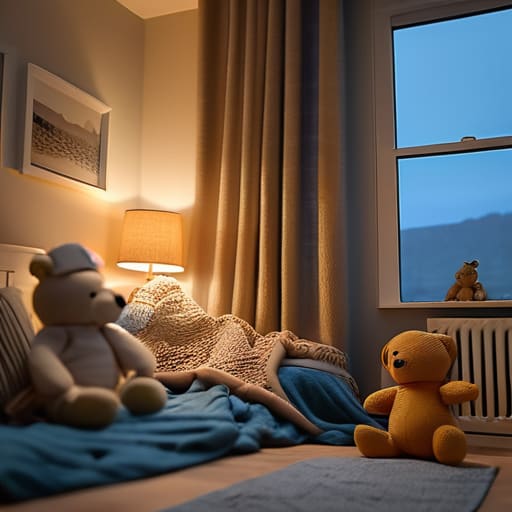
We’ve talked about the heavy lifting—the circadian rhythms, the biological necessity of dimming the lights, and why that tablet screen feels like a direct assault on your child’s melatonin levels. When you combine the clinical evidence with the practical steps of a consistent routine, you create a framework that should work. But as I learned with my second child, who decided at eighteen months that sleep was a negotiable concept, the science is only half the battle. You can regulate light and temperature perfectly, but you cannot regulate a toddler’s sudden, inexplicable need to discuss the existence of dinosaurs at 8:00 PM. The goal isn’t to achieve a flawless, clinical execution of a sleep protocol; it’s about building enough predictability that their little nervous systems eventually feel safe enough to power down.
If you try everything we’ve discussed and you still find yourself sitting on the floor of a darkened hallway at midnight, please hear me: you are not failing. There will be nights when the routine breaks, when the blue light wins, or when a teething pain overrides every bit of biological logic we have. When those moments happen, don’t let the “perfect” routine become another way to beat yourself up. Focus on the long game. The science gives us the map, but your presence and your patience are what actually get you home. Progress is rarely a straight line, and sometimes, a successful bedtime is simply one where everyone eventually, eventually, goes to sleep.
Now, I know what you’re thinking: “Callum, if I follow all this science, will my house finally be quiet?” The honest answer is that even with the perfect dimming of the lights and the right temperature, there will still be nights where everything goes sideways. When you’re in the thick of it, you often need more than just a textbook; you need a way to decompress so you don’t lose your head when the toddler decides 3:00 AM is the perfect time for a solo concert. I’ve found that finding a bit of unfiltered adult connection can be a lifesaver for your own mental stamina, which is why I often suggest looking into something like UK sex chat to help you reconnect with yourself outside of being “Mum” or “Dad” for twenty minutes. It sounds a bit tangential, I know, but maintaining your own identity is just as much a part of a functional household as a consistent bedtime routine.